The derelict windmill in the field was built in 1832, but in 1895 there was a great storm which blew the sails and top off.
Great fires of Luffenham – There have been two major fires thefirst in 1874 when a six year old was playing with matches which spread from The Square across to Pinfold Lane and in 1913 when a spark from a Football Special set alight a thatched cottage and then destroyed 2 farms, a butchers shop, 5 cottages and 2 straw stacks.
Railway – There were 13 trains a day on the old Stamford to Seaton line. The trains were affectionately known as Wessy, Push & Pull and Puff & Dart.
The Common – 14th century to 1882 One night as the fog came down an elderly lady walking from Tixover to Luffenham heard the church bells tolling which guided her back home. ln gratitude she donated a plot of land to the village and the income from it paid for the sexton to ring the bells from 8am to 8pm daily from October to March. The field (opposite The Coach House lnn) became known as Bellfield, other names given to it were Bellringers Field and Feast Field.
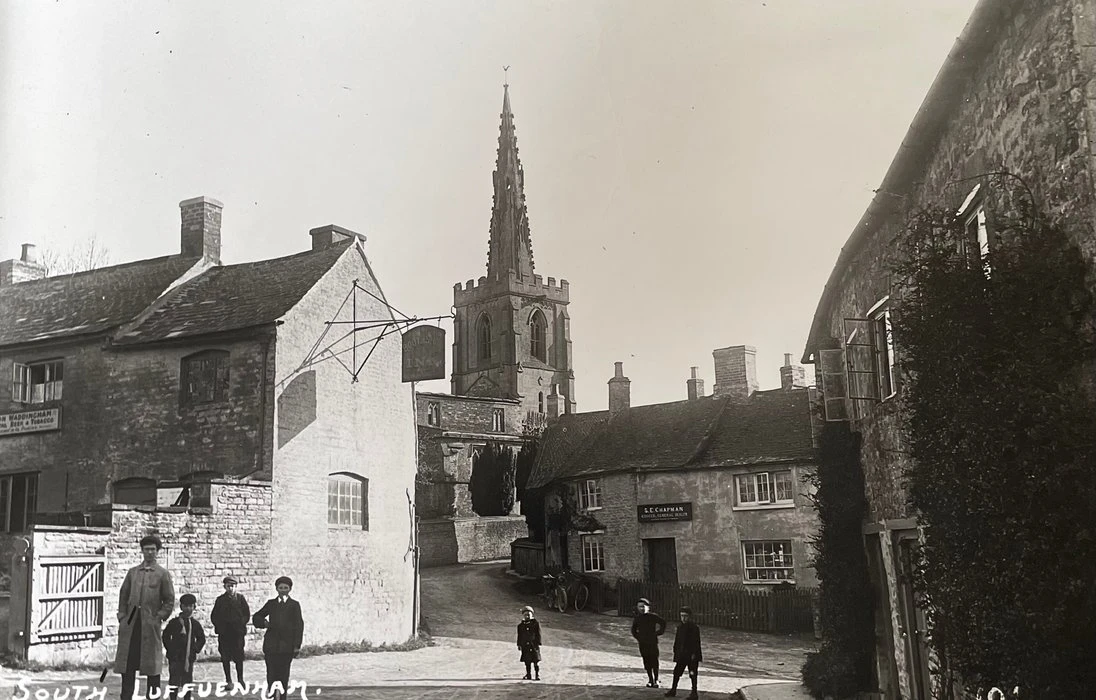
The Coach House lnn was known as The Halfway House as it is halfway between Birmingham and Norwich via Leicester, South
Luffenham and Stamford. Ostler’s Cottage was part of the inn with stabling for the coach horses.
ln 1882 the Earl of Ancaster gave the village the Recreation Ground and Allotment Land in exchange for The Common as part of the Enclosure Act 1920 Golf Course built. Cannonball Lane (Bridleway Luffenham to Morcott) Cromwell’s men set up cannons in the spinney to fire on North Luffenham.
Shocky Balke – Led up from the top of Pinfold Lane (where the Penfold was built for drovers to shelter there animals overnight on the way to market) to The Common after which it became knownas Hangman’s Lane as it went up to where the gallows were situated. (Close to telephone towers) The Common stretched from Barrowden Lane to Fosters Bridge. Fosters Bridge is named after man who hung himself there.
ln 1793 a tribe of gypsies and their King was camping in the fields known as The Follies, his daughter Rose at just 17 years of age was dying of consumption and was too ill to travel so they stayed there a further two months. When she died the churchwardens of the parish would not let her be buried in the churchyard because she was not a Christian. The Rev. Bateman over-ruled his parishioners and she was buried in the south aisle of the church befitting her status as a Princess. A few weeks later a slab of marble arrived from London and placed over her remains. The slab is still faintly discernible in the Church today.
Morcott Road – A red brick barn was built and was used as dance hall in Victorian Times between the villagers of Morcott and Luffenham.
Adam & Eve Barn, The Street – the barn had a stone set in the wall above where grain was hoisted up. On the stone is a depiction of Adam & Eve which is thought to mean fertility and good times for Harvest. When the barn was sold one of theconditions was the stone had to remain with the building.